
Chapter 5 — Stans, Rotzloch and the legend of the Lindwurm
A day on foot in Nidwalden: a gorge, a ruined castle, a plain that carries the dragon in its name, and an old man who tells the story of the Lindwurm. This page follows the route and gives the sources of the legend.
The route of chapter 5
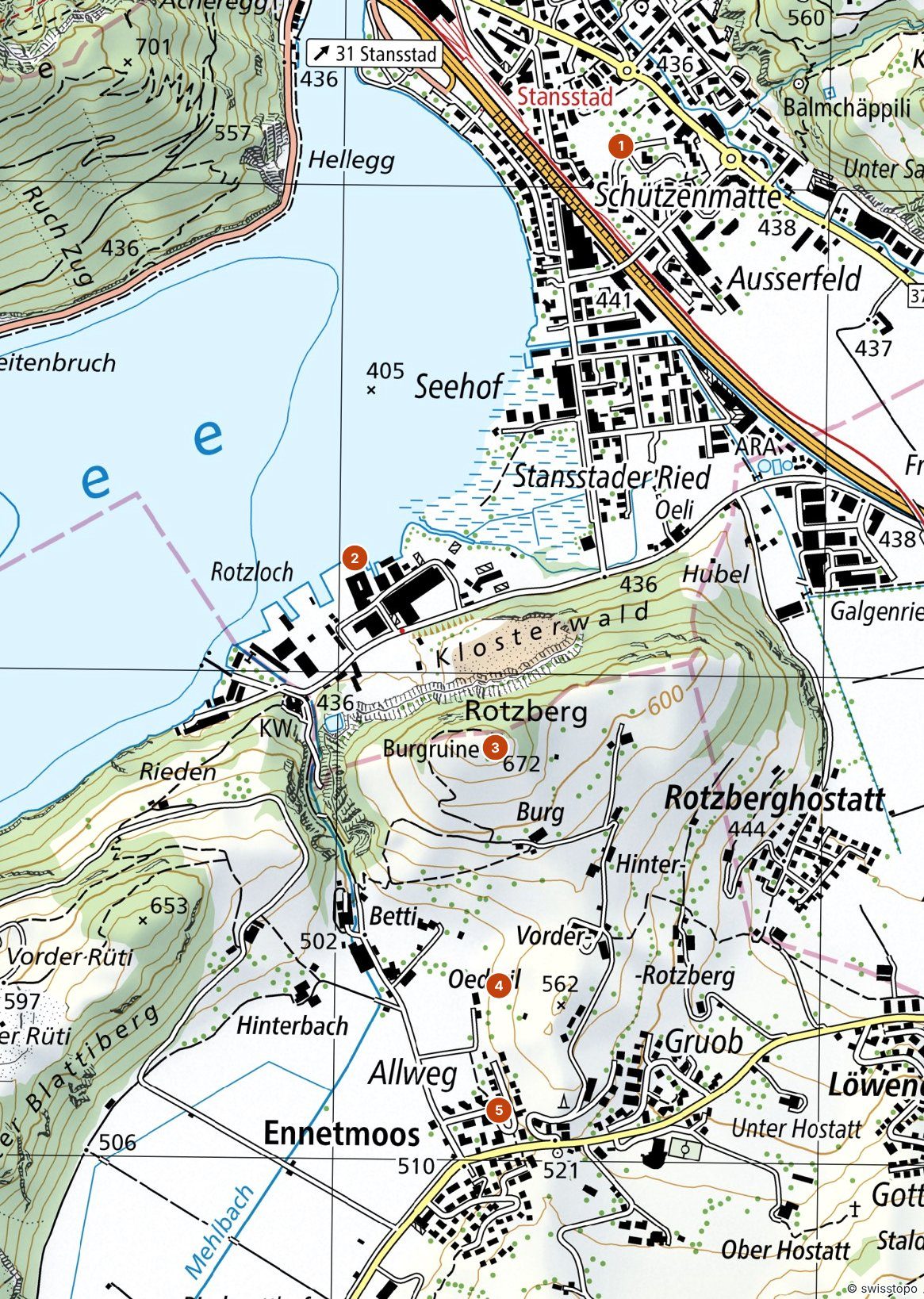
- 1StansstadTrain from Lucerne, a quarter of an hour.on foot: two kilometres along Lake Alpnach
- 2RotzlochThe gorge, the cave, the two little dragons on the wall.on foot: steep climb through the meadows
- 3RotzbergThe castle ruins and the view over the Drachenried.on foot: down through the meadows
- 4OedwilOne or two houses, and a name that comes from the legend.on foot
- 5Allweg and EnnetmoosThe 1798 monument, the dragon coat of arms, Sepp’s bench.bus 312
- 6StansThe Church of St Peter and Paul and the Winkelried monument. Train back to Lucerne.
The places in the chapter
The Bürgenstock and the Hammetschwand lift
In the book: first scene
From the shore at Stansstad you can see the Bürgenstock and its cliff above the lake. Up the rock face runs the Hammetschwand lift, opened in 1905: about 150 metres, the highest outdoor lift in Europe. “One day, I’ll go up there too,” Véronique promises herself.
The Rotzloch
In the book: first scene
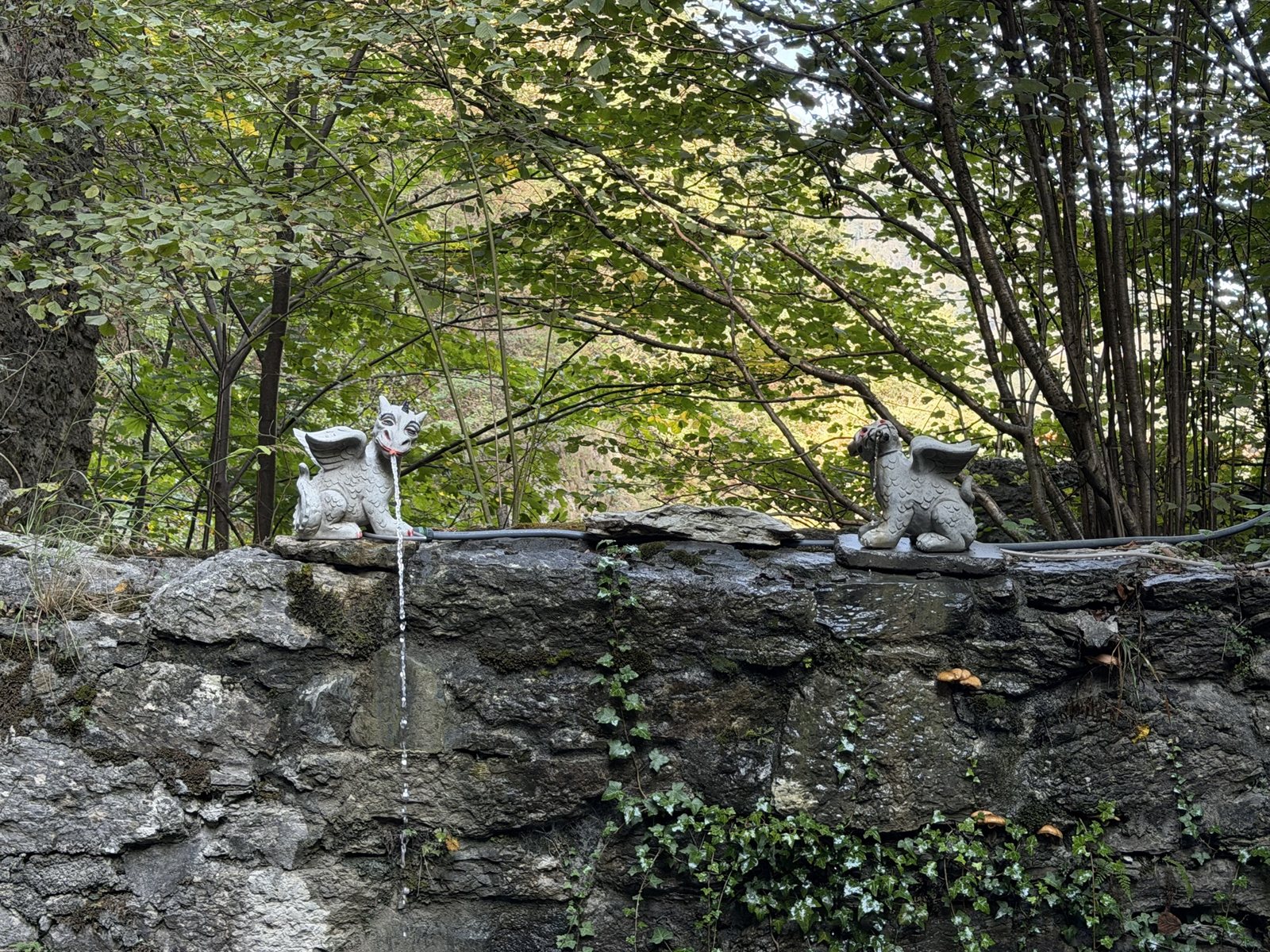
At the end of Lake Alpnach, the Mehlbach stream has carved a narrow gorge, with waterfalls, ferns, a cave and a small tunnel. The place was one of the first industrial sites in the region: a paper mill from 1597, then a grain mill, oil mill, powder mill, sawmill, tannery and forge; in the 19th century a hotel with baths, and in 1882 a cement works.
On an old wall, a remnant of the former workshops, two little dragons stand guard; one of them spouts water.
The Rotzloch cave
In the book: first scene
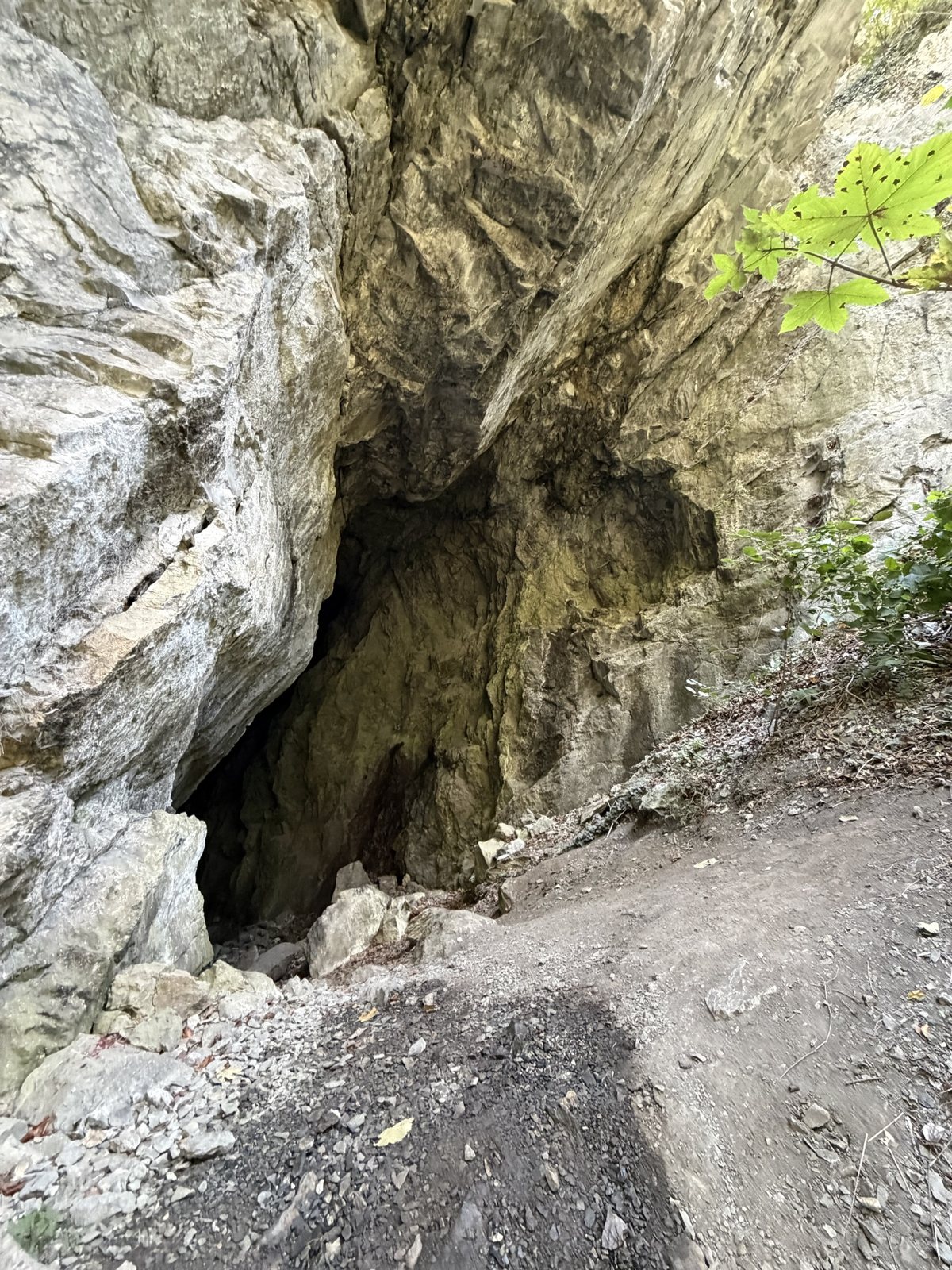
The path runs at the foot of the cliffs, past the dark mouth of a cave. The path is narrow and damp: good shoes recommended, and take care under the rock faces.
The ruins of Rotzberg
In the book: first scene
At the top of the hill, a five-sided curtain wall, in places more than one and a half metres thick, protected to the west by a six-metre ditch. It dates from about 1150; the castle was abandoned in the 13th century. The chronicler Aegidius Tschudi tells how it was taken by trickery on New Year’s Day 1308, thanks to a maidservant and a rope; excavations have found no trace of violent destruction. In 1910 the Swiss Confederation bought the site to protect it.
From up there, the view opens onto the Drachenried, the plain at the foot of the Mueterschwandenberg and its summit, the Zingel.
Ennetmoos, the Drachenried and Oedwil
In the book: second scene
The coat of arms of Ennetmoos, adopted in 1905, shows a golden dragon on a black field, breathing red flames, pierced by the broken tip of a lance. It recalls the legend of the Lindwurm. The Drachenried, “the dragon’s wet meadow”, is the former marsh west of the village. According to the legend, the people of the village of Wil abandoned it because of the dragon, and the place was then called Ödwil, today Oedwil.
The Allweg monument
In the book: second scene
It commemorates 9 September 1798, when General Schauenburg’s French troops invaded Nidwalden, which had refused the constitution imposed by Paris. Hundreds of people died, and houses and churches burnt. The monument was erected a hundred years later.
Stans
In the book: third scene
On the village square, the Church of St Peter and Paul, built between 1641 and 1647, keeps the Romanesque bell tower of the earlier church. In the middle of the square stands the white marble Winkelried monument by Ferdinand Schlöth (1865): Arnold von Winkelried at the Battle of Sempach in 1386, according to tradition.
The legend of Struthan Winkelried and the Lindwurm
In the book: second and third scenes
A dragon, wingless in some tales, winged and fire-breathing in others, lived in a cave above the Drachenried. A Winkelried, banished for murder, offers to kill it so that he may return home. He thrusts brambles or thorns into the beast’s jaws, then finishes it off with his sword. But the dragon’s poisoned blood runs over him, and he dies of it.
The oldest mention is in the chronicle of Petermann Etterlin (1507). Tschudi places the fight in 1250 and names the hero “Struth von Winkelriedt”. The Brothers Grimm included it in their German Legends (1816), and Meinrad Lienert retold it in 1915. A real knight, Heinrich von Winkelried, appears in a document of 1275.
True or invented?
The book mixes real places, old legends and invented scenes. Here is which is which.
Fact: verifiable (date, place, building). Legend: a traditional tale, told as such. Novel: created for the book.
Fact sheets to go further
Each legend and each topic will have its own full fact sheet, for travelling, discovering or doing research.
- The legend of the Lindwurm of Ennetmoos, in full, with all its versionscoming soon
- The Bürgenstock and the Hammetschwand liftcoming soon
- The Rotzloch: four centuries of workshopscoming soon
- Rotzberg Castle and its capture in 1308coming soon
- Two Winkelrieds: Struthan and Arnoldcoming soon
- 9 September 1798 in Nidwaldencoming soon
Sources
- Petermann Etterlin, Kronica von der loblichen Eydtgnoschaft, 1507
- Aegidius Tschudi, Chronicon Helveticum (16th century)
- Brothers Grimm, Deutsche Sagen, 1816
- Meinrad Lienert, “Das Drachenried”, Schweizer Sagen und Heldengeschichten, Stuttgart, 1915 (sagen.at)
- Nidwalden Tourism, Stans – Rotzloch – Ennetmoos
- Rotzberg Castle (Wikipedia)